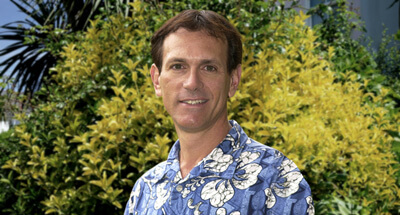
Barry Rolett
Professor
Background
Research Interests
Courses Taught
Background:
I grew up in the 1960s college town of Chapel Hill, North Carolina, surrounded by the woods and with high-school-age James Taylor as a next-door neighbor. My interest in archaeology began in a class taught by Richard "Scotty" MacNeish at Phillips Academy. I majored in English at Pomona College but also worked on summer archaeological field schools at the Salmon Ruin (New Mexico) and at Pincevent, in France after a year of immersion language study at the Sorbonne. At Pomona, a class on Herman Melville led me to discover the Marquesas Islands, the Polynesian archipelago where Melville jumped ship at the age of twenty-one. I reached the Marquesas at age twenty-two, during a year-long Thomas J. Watson Fellowship trip through the South Pacific, and spent a wonderful month living with a Marquesan family on the remote island of Tahuata.
I eventually combined these interests in archaeology and the South Pacific at
Yale where I got my M.A. and Ph.D
Research Interests:
My research focuses mainly on the prehistory of Oceania. Since joining the University of Hawai'i faculty in 1988, I have directed seven summer field projects (five in the
Marquesas, two in Hawai'i). Some of the themes my work explores are Polynesian origins, the emergence of monumental architecture, and the dynamic interplay between prehistoric Polynesians and their island environments. I have also collaborated with geologists to document evidence for the inter-island transport of stone tools made of volcanic rock. This work is of interest in revealing an early period of active voyaging within the Marquesas, followed by a sharp falloff in interisland contact after A.D. 1450. Most recently, I have collaborated with Taiwanese archaeologists in using the geological sourcing of stone tools to document systematic seafaring, beginning as early as six thousand years ago, in the Taiwan Strait.
Courses Taught:
Anth 150 Human Adaptation
This class is an introduction to human adaptation and the evolution of culture. Adaptation, occurring through the process of evolution, has helped humans to survive while influencing developments in physical morphology, as well as in human behavior. The semester will begin with reconstructing the course of human evolution. A series of laboratory exercises allows students to conduct a firsthand examination of the fossil evidence for human evolution. We will also take a field trip to the Honolulu Zoo to see how studies of monkeys and apes, our closest relatives in the animal world, help us understand the lives of our early human ancestors. The second portion of the class focuses on the science of archaeology and archaeological evidence for cultural developments leading to the origins of civilization. We will discuss topics including Paleolithic cave art and the origins of agriculture, as well as the instructor's ongoing archaeological research in the Marquesas Islands or French Polynesia. The final portion of the class concentrates on anthropological studies of present-day peoples, with the goal of understanding the diversity of human cultures.
The grade will be based on a mid-term and final exam, in addition to other small assignments such as the laboratory exercises.
Anth 323 WI/Pacific Island Archaeology
This survey course is an introduction to the prehistory of Polynesia, Micronesia, and Melanesia. We will examine archaeological evidence for origins of the Pacific peoples and for the series of migrations by which they succeeded in settling far-flung islands in diverse environments ranging from the equatorial tropics to temperate New Zealand. In studying the Polynesian chiefdoms, we will compare and contrast divergent sequences of development documenting the independent evolution of cultures descendant from a common ancestral heritage.
Guest lecturers will be invited to speak on their particular specialities in Pacific archaeology and the class will also take an archaeological tour of Bishop Museum, as well as a field trip to visit notable sites on 0'ahu. The instructor is actively involved with ongoing research in French Polynesia (Marquesas Islands and Tahiti) and Hawai'i. This is a writing intensive class. Students will develop a 15 page paper focussed on Pacific prehistory. The mid-term exam will be an out-of-class assignment consisting of essays. The final exam will also include essays, which will count for 50% of the grade.
The course is open to both undergraduate and graduate students. Interested students in fields other than Anthropology are encouraged to enroll and should see the instructor for a waiver of the prerequisite.
Anth 475 Faunal Analysis
This course focuses on archaeozoology--the analysis and Interpretation of archeologically recovered faunal remains. A combination of lectures and laboratory exercises will be oriented around four themes in archaeozoology: 1) reconstructing prehistoric diets and subsistence strategies; 2) inferring human behavior linked with butchery and tool manufacturing techniques; 3) experimental replication of cut marks on bones, using stone tools; and 4) basic quantitative analysis of archaeozoological data. Grading is based mainly on a mid-term examination and a final project consisting of individually conducted laboratory analysis or experimental research. Course requirements are somewhat different for gradate students than for undergraduates. Students without a background in basic skeletal biology either from Anthropology 215 or 381 should consult the instructor before enrolling.
Anth 640C Method & Theory in Archaeology: "Environmental Archaeology"
Environmental archaeology is a contextual approach that investigates the dynamic relationship between humans and their environment. The goal is to understand interaction between prehistoric human communities and their environment, in terms of space, time, and processes of change or equilibrium.
This seminar will cover a broad range of issues, methodologies, and case studies. These topics will be examined in class through discussions and student reports. You will be encouraged to develop your own research interests during the course of the seminar.
Students will be evaluated on the basis of seminar presentations, class participation, and a research paper. Open to graduate and advanced undergraduate students.
Anth 750B Research Seminar: Pacific Island Ethnohistory
Early historic accounts and travel narratives offer detailed firsthand descriptions of Pacific Island cultures at the time of European and American contact. This seminar focuses on the use of these historic documents in investigating problems in Pacific ethnology and archaeology. One goal will be to survey the range and scope of available archival resources, including those at Hamilton
Library, the Bishop Museum, and the Hawaiian Children Mission Society. We will also examine different approaches to working with these resources, and the inherent problem of western biases in the portrayal of Pacific peoples.
Anth 750B Research Seminar: Archaeology
Only a decade ago, many Polynesian archaeologists believed that the days of pioneering research were over and that future studies would serve largely to refine and elaborate upon past work. Today, a profusion of recent advances have jolted the once widely accepted foundation of knowledge on Polynesian prehistory, and the current norm is debate rather than consensus.
This seminar will focus on the recent advances and current debates, with a view towards identifying promising avenues for future research. Topics for investigation will include: environmental change as a means for understanding and dating human colonization; two-way voyaging and interaction spheres; evidence for prehistoric homelands; and social complexity and the emergence of monumental architecture. This seminar provides an excellent opportunity for students to explore a subject of particular interest in depth. Students will present results of their independent research in a term paper, as well as in a formal class presentation.
Home |
People |
Programs |
Courses |
News & Events |
Resources |