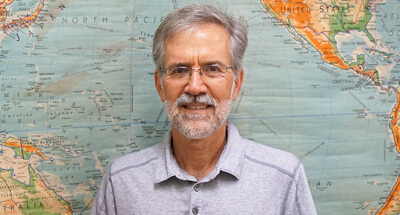
James M. Bayman
Associate Professor
Background
General Interests
Selected Writings
Courses Background:
I received my Ph.D. in anthropology from Arizona State University in 1994. My archaeological research is focused on the political economy and organization of traditional societies in the Hawaiian Islands and the North American Southwest. The organization of traditional stone adze economies in the Hawaiian Islands -- before and after European contact -- is one particular focus of my Pacific research. My current research in North America centers on the economy and politics of property and social identity in south-central Arizona prior to European contact.
Community-service archaeology is an important component of my work in the Hawaiian Islands. Among other things, I have been involved in Malama Kaniakapupu, a loose-knit organization (hui) that includes Native Hawaiians, archaeologists, and other people who are interested in the culture and history of the islands. This organization is especially dedicated to preserving and celebrating the cultural heritage of Kaniakapupu, on the island of O'ahu. Kaniakapupu was a royal residence of King Kamehameha III (Kauikeaouli), the paramount head of state for the sovereign Hawaiian kingdom in the mid-19th century.
General Interests:
Political economy, property, craft economies, Oceania, Hawaiian Islands, North America
Selected Writings: Selected Writings:
2007 Papaguerian Perspectives on Economy and Society in the Sonoran Desert. In Hinterlands and Regional Dynamics in the American Southwest, edited by Alan P. Sullivan, III, and James M. Bayman, pp. 109-124. The University of Arizona Press, Tucson.
2005 Plausible Ethnographic Analogies for the Social Organization of Hohokam Canal Irrigation (with R. Hunt, D. Guillet, D. Abbott, P. Fish, S. Fish, K. Kintigh, and J. Neely). American Antiquity 70:433-456.
2004 Stone Adze Production and Resource Extraction at Pohakuloa, Hawai'i Island (with J. Moniz-Nakamura, T. Rieth, and C. Paraso). Hawaiian Archaeology 9:83-104.
2004 The Paleoecology and Archaeology of Long-Term Water Storage in a Hohokam Reservoir, Southwestern Arizona (with M. Palacios-Fest, S. Fish, and L. Huckell). Geoarchaeology: An International Journal 19: 119-140.
2003 Stone Adzes in Post-Contact Hawaii. In Stone Tool Traditions in the Contact Era, edited by Charles R. Cobb, pp. 94-108. University of Alabama Press, Tuscaloosa.
2002 Hohokam Craft Economies and the Materialization of Power. Journal of Archaeological Method and Theory 9:69-95.
2001 Craft Specialization and Adze Production on Hawai'i Island (with J. Moniz-Nakamura). Journal of Field Archaeology 28:239-252.
2001 The Hohokam of Southwest North America. Journal of World Prehistory 15 (3):257-311.
1999 Dynamics of Hohokam Obsidian Circulation in the North American Southwest (with M. Shackley). Antiquity 73 (282):836-845.
1999 Craft Economies in the North American Southwest. Journal of Archaeological Research 7(3):249-99.
Courses Taught:
Anth 210 (Introduction to Archaeology)
The purpose of this course is to provide students with an introduction to the methods and theory used by anthropological archaeologists to reconstruct and interpret past lifeways. The course examines: 1) the history, goals, and theory of archaeology, 2) methods for acquiring archaeological data, including site discovery and excavation, 3) techniques for analyzing artifacts and other archaeological remains, 4) approaches for reconstructing and interpreting the past, 5) the relevance of archaeology to contemporary society. Although examples of real-world archaeological research will be used to illustrate key concepts, the course does not entail an in-depth review of the archaeology of any particular region.
Anthropology 321 - World Archaeology I
This writing-intensive course will provide students with an introduction to the archaeology of human biological evolution and the technologies and economies of early cultures throughout the world. Specific topics we will consider include (but are not limited to) early fire use, the development of stone technologies, foraging subsistence economies, early plant domestication and food production, and sociopolitical organization in pre-state village societies. Although this course is global in its geographic coverage, well-known areas will be more heavily emphasized.
Anthropology 322 - World Archaeology II
This Writing-Intensive course provides students with a general introduction to the anthropological archaeology of ancient complex societies (i.e., states and empires) throughout the world to ca. AD 1500. Geographic areas that we will study include Africa, East/South and SE Asia, the Near East, and the New World. We will examine a variety of societies including (but not limited to) the ancient Nubians, Egyptians, Greeks, Romans, Aztecs, Inca and Maya. Topics we will consider during the course include the origin and elaboration of cities and urbanism, writing systems, economy and technology, monumental architecture, and socio-political organization in ancient civilizations. A major goal of this course is for students to develop an archaeological perspective on the social, economic, and environmental factors that lay behind the emergence of ancient complex societies.
Anth 380 (Archaeological Laboratory Techniques)
This course offers students an introduction to the principles and practice of laboratory techniques and the integration of this activity with problem-oriented archaeological research. Topics that we consider include: 1) the role of laboratory work in research design, 2) techniques of artifact analysis and interpretation, and 3) the preparation of professional reports and papers. Although analyses for this course will emphasize lithic and ceramic artifacts, other materials will also be examined including, floral and faunal remains, bone and shell artifacts, and historical artifacts. Our laboratory work will focus on current UH-sponsored research in Hawai'i and Southeast Asia (Cambodia). Students will learn fundamental laboratory techniques by participating in these ongoing research projects.
Anth 381 (Archaeological Field School)
TBA
Anth 468 (Archaeological Theory & Interpretation)
This course provides students with an introduction to theory and interpretation in the practice of contemporary archaeology. Archaeological theory is the conceptual basis for interpreting and explaining the past using the archaeological record. We examine the role of theory in shaping our questions about the past, the role of theory in governing the methods that we devise to answer such questions, and the role of theory in guiding our interpretations of the past. We also study and evaluate different applications of archaeological theory from different perspectives including cultural historical, processual, and post-processual. Students acquire an in-depth knowledge of how archaeologists construct and use theory.
Anth 640 (Economic Archaeology)
This graduate seminar focuses on theoretical and methodological issues that concern past economies from the perspective of anthropological archaeology. Initially, the seminar emphasizes defining "economic archaeology," tracing its history and development, and examining its relevance to contemporary archaeology. The bulk of the seminar, however, centers on critically evaluating the utility of different theoretical frameworks and archaeological models that have been proposed to explain ancient economies. Throughout the seminar we explore the social and ecological factors that governed the production, circulation, and consumption of material means, and established points of articulation between subsistence economies and political economies. A diverse array of topics are considered including, economic intensification and craft specialization, household organization and labor deployment, and resource allocation and exchange. Students gain a valuable knowledge of economic archaeology that can be productively applied to his/her research, irrespective of geographical or topical specialty.
Home |
People |
Programs |
Courses |
News & Events |
Resources |